
Archives
Result

Blog • 13 August 2025
4 Challenges Solved by Acumatica Supply Chain Management
Running a supply chain can feel like juggling flaming torches while riding a unicycle—exciting but also stressful and risky. Between managing inventory, meeting deadlines, coordinating suppliers, and keeping customers happy, you’ve got a lot on your plate. Thankfully, Acumatica Supply Chain Management is here to take some of that pressure off your shoulders.
In this post, we’ll look at four common supply chain challenges and how Acumatica makes solving them feel less like a headache and more like a win.
Challenge #1: Losing Track of Inventory
We’ve all been there—you think you have enough stock, only to find out you’re running dangerously low at the worst moment. This not only frustrates your team but also leads to disappointed customers.
With Acumatica Supply Chain Management, inventory tracking becomes easier than checking your phone for the weather. The system gives you real-time visibility into stock levels, locations, and movement, so you always know exactly what you have and where it is.
Even better, you can set automatic reorder points, so the system alerts you or even orders products when stock gets low. It’s like having a personal inventory assistant who never takes a day off.
Challenge #2: Slow and Unreliable Supplier Communication
If your suppliers don’t deliver on time, your entire operation can come to a screeching halt. Delays cause frustration, increased costs, and unhappy customers.
Acumatica Supply Chain Management helps by centralizing supplier information, tracking performance, and automating communication. You can see who consistently meets deadlines, who needs follow-ups, and who might be slowing things down.
Instead of chasing suppliers with endless emails, you can manage everything in one platform—making collaboration smoother and relationships stronger. It’s like turning supplier chaos into a well-rehearsed dance routine.
Challenge #3: Poor Demand Forecasting
Guessing what your customers will want next month isn’t exactly a strategy you can rely on. Without accurate forecasting, you risk overstocking or running out of popular products.
That’s where Acumatica Supply Chain Management shines. It uses historical sales data, seasonal trends, and real-time analytics to help you make smarter purchasing decisions. This means you’re less likely to waste money on excess stock or lose sales due to shortages.
You’ll feel more confident when placing orders because your decisions are backed by data, not just gut instinct. And when customers get exactly what they want, they’ll see you as a reliable, professional business.
Challenge #4: Inflexible Systems That Can’t Keep Up
Many businesses still use outdated software or multiple disconnected tools that make managing the supply chain slow and complicated. When your systems can’t keep up, neither can your business.
Acumatica Supply Chain Management is cloud-based, so it’s flexible, scalable, and always up to date. You can access it from anywhere—whether you’re in the office, on the factory floor, or relaxing at home.
As your business grows, the system grows with you. Adding new warehouses, products, or users is quick and painless, so you’re never stuck with limitations that slow you down.
Why It Works So Well
What makes Acumatica Supply Chain Management different is how it blends automation, real-time insights, and flexibility into one platform. You don’t have to jump between spreadsheets, email threads, and outdated systems anymore. Everything you need is in one place, easy to find, and even easier to use.
With these tools, you’re not just reacting to supply chain problems—you’re preventing them before they happen. That’s the kind of proactive approach that saves money, boosts efficiency, and keeps customers happy.
Partnering for Success
While the software itself is powerful, having the right partner to guide you can make all the difference. Experts like Edsen Consulting help you set up, customize, and optimize Acumatica for your unique business needs. They make sure you’re getting the most out of every feature, so your supply chain runs like a finely tuned machine.
Final Thoughts
Supply chain management doesn’t have to be stressful. With Acumatica Supply Chain Management, you can tackle common challenges like inventory confusion, supplier delays, poor forecasting, and outdated systems with confidence.
✅ Ready to make your supply chain a competitive advantage instead of a daily struggle? Explore what Acumatica can do for your business and see how much easier managing your operations can be.

Blog • 12 August 2025
4 Fun Facts About Acumatica Supply Chain Management
Let’s be honest—most people don’t think “fun” when they hear “supply chain management.” You probably imagine warehouses, invoices, and endless spreadsheets instead of exciting discoveries. But here’s the surprise: Acumatica Supply Chain Management actually has some pretty cool features that can make your workday a whole lot easier—and maybe even enjoyable.
In this article, you’ll learn four fun facts about this powerful system that might just change the way you see supply chains forever.
Fun Fact #1: It’s Like GPS for Your Inventory
Imagine if your products could raise their hands and say, “Hey, I’m over here!” That’s kind of what Acumatica Supply Chain Management does for your inventory.
Instead of walking through aisles trying to guess where items are stored, you can check real-time data to see exact locations. Whether the goods are in your main warehouse, a regional hub, or even in transit, you always know where they are.
This means you spend less time searching and more time making important decisions. It’s basically turning hide-and-seek into a perfectly organized game where you always win.
And here’s the best part—you can access that information anytime, from anywhere. So even if you’re at a coffee shop, you can still check inventory without missing a sip of your latte.
Fun Fact #2: It Can Order Stuff for You
Ever had that “oh no, we’re out of stock” moment? With Acumatica Supply Chain Management, you can almost completely avoid it. The system can automatically reorder items when your stock levels drop below a set limit.
You set the rules—minimum stock levels, preferred suppliers, and lead times—and the software does the rest. It’s like having an assistant who never forgets, never sleeps, and never takes a vacation.
This means fewer emergency orders, fewer disappointed customers, and a lot less stress for you. And yes, you’ll still look like the hero who keeps everything running perfectly on time.
Fun Fact #3: It Rates Your Suppliers Like a Game Show Judge
Wouldn’t it be nice if you could instantly know which suppliers are top performers? Well, Acumatica Supply Chain Management does exactly that. It tracks supplier performance and shows you who delivers on time, who’s consistent, and who’s… let’s just say “a bit slow.”
It’s like having your own version of a game show where suppliers get rated based on reliability, speed, and cost efficiency. The winners get more of your business, and the underperformers get some friendly coaching—or maybe a replacement.
This helps you maintain a healthy supply chain while also improving relationships with your best partners. Plus, you’ll have hard data to back up any negotiation, making you both smart and confident in your decisions.
Fun Fact #4: You Can Run It From the Beach
Okay, maybe you won’t be on the beach every day, but with Acumatica Supply Chain Management, you technically could be. That’s because it’s cloud-based, meaning you can log in from anywhere with an internet connection.
You can check inventory, approve purchase orders, and review reports without being stuck at your desk. This gives you the flexibility to work from home, a coffee shop, or yes—even a hammock on a sunny beach.
It’s the freedom that lets you manage your business without sacrificing your lifestyle. You stay in control, but you’re no longer tied down by location.
Why Partnering With Experts Makes It Even Better
While Acumatica Supply Chain Management already gives you powerful tools, having an experienced partner like Edsen Consulting can make the experience smoother. They help you customize the system to your industry, train your team for maximum efficiency, and ensure you’re using every feature that can give your business an edge. Think of them as your personal supply chain tour guides—helping you navigate with confidence and speed.
Wrapping It Up
Who knew supply chain management could actually be interesting? From GPS-style inventory tracking to automated ordering, supplier scorecards, and cloud-powered freedom, Acumatica Supply Chain Management makes your business life easier and smarter.
The best part is that you get to focus more on growth and strategy while the system handles the repetitive stuff in the background. Your supply chain stops being a headache and starts being a competitive advantage.
✅ Ready to see how fun and easy supply chain management can be? Explore the possibilities with Acumatica and discover how much smoother your business can run.
Blog • 11 August 2025
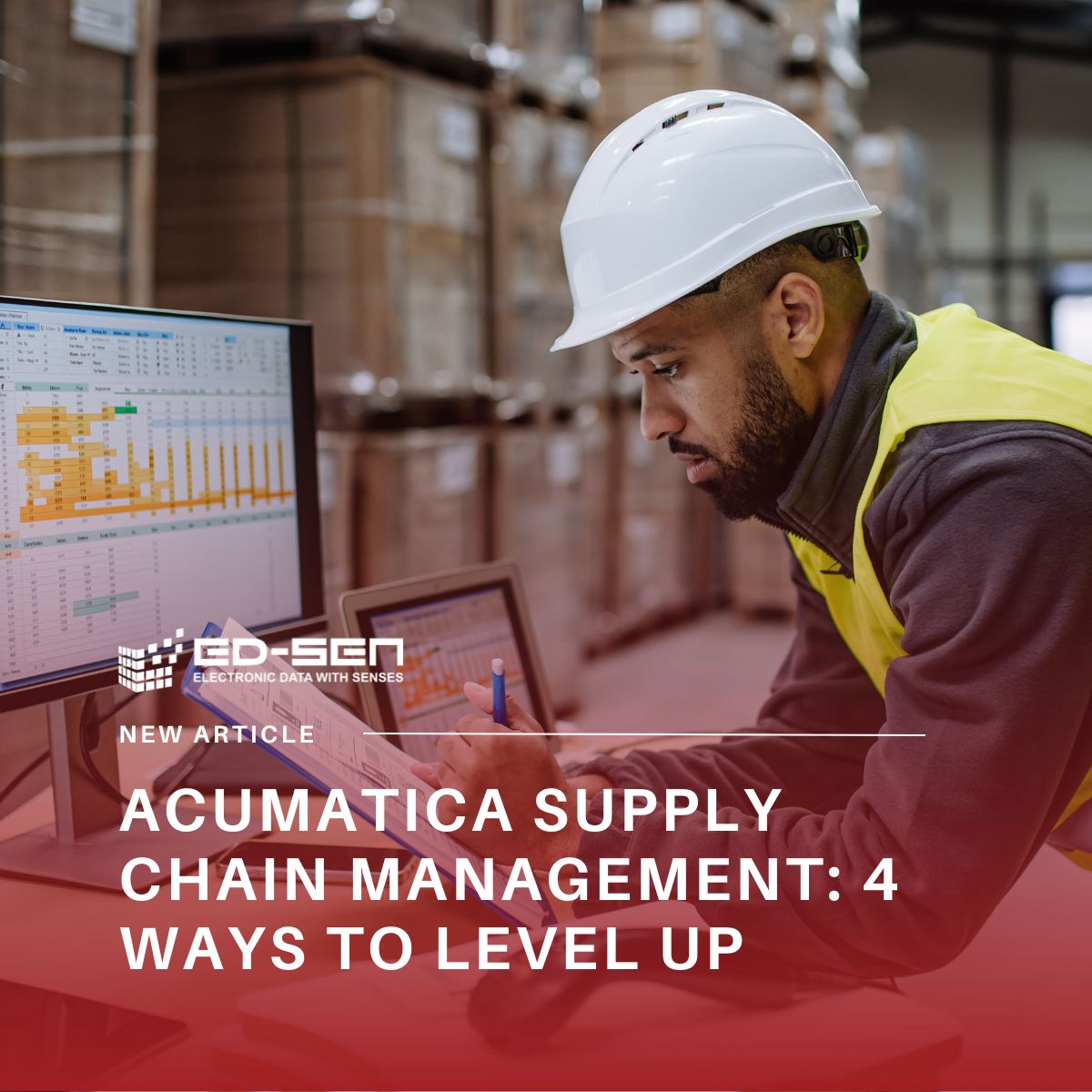
Acumatica Supply Chain Management: 4 Ways to Level Up
Managing a supply chain can sometimes feel like juggling flaming swords on a unicycle. You must keep everything moving without dropping anything important. That’s where Acumatica Supply Chain Management makes a huge difference. It’s like swapping that unicycle for a comfortable SUV with autopilot. You still steer, but everything runs much smoother.
In this article, you’ll discover four ways Acumatica Supply Chain Management helps level up your business and simplify your daily operations.
1. Smarter Inventory Tracking Without the Stress
You can’t manage what you can’t see. If you still use outdated spreadsheets, your inventory may feel more like “hide and seek” than “supply chain management.” Acumatica Supply Chain Management changes that.
With real-time tracking, you can see stock levels across warehouses, store locations, and even shipments in transit. Imagine knowing exactly how many units you have and where they are—without guessing.
This visibility reduces overstock, prevents shortages, and keeps your cash flowing instead of sitting in unsold inventory. Your warehouse team will thank you. Your finance team will thank you. And most importantly—your customers will thank you.
2. Automated Purchasing That Saves You Hours
Purchasing doesn’t have to be a never-ending cycle of reorders and supplier follow-ups. Acumatica Supply Chain Management can automate much of this process for you.
You simply set your minimum stock levels, and the system generates purchase orders automatically. Need bolts, fabrics, or coffee beans? Done. The order is sent before you even realize you’re running low.
This automation means fewer last-minute supplier calls and no duplicate orders. You save hours every week and reduce the risk of running out of essential items.
3. Real-Time Supplier Performance Insights
Not all suppliers deliver the same quality or speed. Acumatica Supply Chain Management gives you detailed reports so you can track supplier performance.
You’ll see who delivers on time, who is consistently late, and who costs you more than expected. With this insight, you can negotiate better deals, set expectations, or find new suppliers if necessary.
The data is presented in easy-to-read dashboards, helping you spot trends and make better supply chain decisions. It’s like having a scoreboard for your suppliers—so you win more often.
4. Mobile Access for On-the-Go Decisions
Supply chains don’t pause when you’re away from your desk. With Acumatica Supply Chain Management, you have mobile access to your operations anytime.
You can approve purchase orders, check stock, or review supplier performance from your phone or tablet. This lets you solve problems instantly instead of waiting until you return to the office.
Your team also benefits. The warehouse manager can update inventory from the floor. Sales teams can confirm stock for big orders during client meetings. You can even manage everything from a beach café—if that’s your style.
Level Up Your Supply Chain Today
Managing your supply chain doesn’t have to be complicated or stressful. With Acumatica Supply Chain Management, you get better inventory control, automated purchasing, supplier insights, and mobile access.
You’ll experience fewer surprises, happier customers, and a lot less stress. That means more time for growing your business and less time chasing missing shipments.
✅ Ready to level up your supply chain? Discover how Acumatica can enhance your business operations and provide a competitive edge today.
Why Partnering With Experts Like Edsen Consulting Helps
While Acumatica Supply Chain Management is powerful on its own, getting the right setup and customization can take it to another level. That’s where Edsen Consulting comes in. As an experienced Acumatica partner in Indonesia, they help you tailor the system to your industry needs, integrate it with your existing tools, and train your team for smooth adoption. With their guidance, you can unlock the full potential of your supply chain and avoid costly implementation mistakes.
Acumatica ERP Manufacturing • 8 August 2025
How to Measure ROI on ERP: A 4-Step Guide for 2026
Investing in an Enterprise Resource Planning (ERP) system is one of the most significant strategic decisions a company can make. It requires a substantial commitment of time, resources, and capital. Naturally, stakeholders from the CFO to the CEO will ask the critical question: "What is the return on this investment?" Learning how to measure ROI on ERP is not just an accounting exercise; it's a vital process for building a business case, justifying the expenditure, and ensuring the project delivers real, quantifiable value.
This comprehensive guide will walk you through a clear, step-by-step process for calculating ERP ROI and deeply knowing how to measure ROI on ERP by moving beyond simple cost-cutting to understand the full strategic impact of your investment.
Table of Contents
- Understanding ERP ROI: Tangible vs. Intangible Benefits
- The Essential ERP ROI Calculation Formula
- A 4-Step Guide to Knowing How to Measure ROI on ERP
- The Acumatica Advantage: Maximizing Your ERP ROI from Day One
1. Understanding ERP ROI: Tangible vs. Intangible Benefits
Before diving into the calculation, it's crucial to understand that how to measure ROI on ERP system comes in two forms:
- Tangible (Hard) Benefits: These are the direct, quantifiable financial gains that are easily measurable. Examples include reduced inventory costs, lower administrative overhead, and improved production throughput.
- Intangible (Soft) Benefits: These are strategic advantages that are more difficult to assign a precise dollar value to but are often the most impactful. Examples include improved customer satisfaction, faster decision-making, and enhanced data security.
A credible ROI analysis must consider both types of benefits to paint a complete picture of the ERP's value.
2. The Essential ERP ROI Calculation Formula
The standard formula for calculating Return on Investment is straightforward:
ROI (%) = (Net Gain from Investment - Cost of Investment) / (Cost of Investment) x 100
- Cost of Investment: This is the Total Cost of Ownership (TCO) of the ERP system.
- Net Gain from Investment: This is the sum of all your tangible financial benefits plus the estimated value of your intangible benefits.
The key to a successful analysis is accurately identifying and quantifying the variables that go into this formula.
3. A 4-Step Guide to Measuring Your ERP ROI
Follow this structured process to build a comprehensive and defensible ROI calculation.
Step 1: Calculate the Total Cost of Ownership (TCO)
The first step in understanding how to measure ROI on ERP is to calculate the full investment cost. TCO includes much more than just the initial software price. Be sure to account for:
- Software Costs: Subscription fees (for Cloud ERP) or license fees (for on-premise).
- Implementation Costs: Fees for your implementation partner, data migration, and system configuration.
- Hardware & Infrastructure: Costs for servers and network upgrades (primarily for on-premise systems).
- Training Costs: The cost of training your employees to use the new system effectively.
- Ongoing Maintenance & Support: Annual fees for support and system updates.
Step 2: Identify and Quantify Tangible Benefits
Next, by knowing how to measure ROI on ERP, the next is identify all the measurable "hard" savings and revenue gains. Work with department heads to gather baseline data and project realistic improvements. Common areas include:
- Reduced Inventory Costs: Calculate savings from lower carrying costs, reduced obsolescence, and better inventory turnover.
- Increased Productivity / Reduced Labor Costs: Quantify time saved by automating manual tasks (e.g., data entry, report generation) and multiply by employee wage rates.
- Reduced IT & Operational Costs: Sum the costs of legacy systems (maintenance, support fees) that the new ERP will replace.
- Improved Accounts Receivable: Calculate the cash flow benefit of reducing your Days Sales Outstanding (DSO) through faster, more accurate invoicing.
Step 3: Assess and Estimate Intangible Benefits
This step separates a basic calculation from a strategic one. While you can't measure these with perfect precision, you can estimate their financial impact.
- Improved Decision-Making: How much value is there in having real-time data to prevent one bad purchasing decision or to identify a profitable new market trend?
- Enhanced Customer Satisfaction: Link higher satisfaction scores to improved customer retention rates and calculate the value of that retained revenue.
- Increased Agility & Scalability: How much more quickly can your business scale or adapt to market changes with a unified system?
Step 4: Put It All Together and Calculate
With your TCO and a comprehensive list of benefits, you can now plug the numbers into the ROI formula. In addition to the final ROI percentage, you should also calculate the Payback Period—the time it will take for the accumulated benefits to equal the initial investment cost. This provides a clear timeline for when the system will have "paid for itself."
The Acumatica Advantage: Maximizing Your ERP ROI from Day One
Understanding how to measure ROI on ERP is critical, but choosing a platform designed to maximize that return is even more important. Acumatica Cloud ERP is built to deliver exceptional value and a faster, more significant ROI.
Here’s how Acumatica directly impacts your ROI calculation:
- Lower, More Predictable TCO: As a true cloud ERP, Acumatica eliminates the need for expensive on-premise hardware and maintenance, significantly reducing your initial investment cost.
- Growth-Friendly Licensing: Acumatica’s unique unlimited user model means you can grow your company without the punitive cost of adding per-user licenses. This dramatically enhances the ROI for growing businesses.
- Industry-Specific Functionality: With tailored editions for Manufacturing, Distribution, Retail, and more, you get the features you need out of the box. This accelerates implementation, boosts user adoption, and reduces customization costs.
- Embedded BI and Analytics: Acumatica empowers your team with the tools for better decision-making (a key intangible benefit) from day one, without requiring third-party software.
Don't just invest in an ERP—invest in a platform designed for a superior return. Contact Ed-Sen Consulting today to discover how Acumatica Cloud ERP can deliver the value and you will be understand how to measure ROI on ERP on your business.
Blog • 7 August 2025
Calculating ERP ROI: A 5-Step Guide to Justify Your Investment
Calculating ERP ROI is one of the most critical steps in the journey to digital transformation. An Enterprise Resource Planning (ERP) system is a significant investment, and for a business case to be successful, stakeholders need to see a clear path to a positive return. A thorough and realistic ROI analysis not only justifies the initial expenditure but also sets clear benchmarks for measuring the project's success long after implementation.
However, a proper calculation goes beyond simple cost savings. This guide provides a clear, 5-step framework to help you build a comprehensive and defensible financial case for your ERP investment.
Table of Contents
- Understanding the Core Components of ERP ROI
- The ERP ROI Formula: Calculating ERP ROI
- A 5-Step Guide to Calculating ERP ROI
- Maximizing Your Return: Why Your ERP Choice Matters
- The Acumatica Advantage: A Superior ROI by Design
1. Understanding the Core Components of ERP ROI
Before you can calculate the return, you must first understand the two sides of the equation: the full cost of the investment and the total value of the benefits.
- The Costs (Total Cost of Ownership - TCO): This includes all direct and indirect costs associated with the ERP over its lifecycle. It's more than just the software price tag. Key components include software subscriptions, implementation and configuration fees, data migration, hardware (if applicable), employee training, and ongoing support.
- The Returns (Benefits): These are broken into two categories:
- Tangible Benefits: Direct, quantifiable financial gains that are easy to measure, such as reduced inventory carrying costs or decreased administrative overhead.
- Intangible Benefits: Strategic advantages that are harder to assign a precise dollar value but are often more impactful, such as improved customer satisfaction or faster, data-driven decision-making.
2. The ERP ROI Formula
The standard formula for calculating ERP ROI is:
ROI (%) = (Net Gain from Investment - Cost of Investment) / (Cost of Investment) x 100
A successful analysis depends entirely on the accuracy and completeness of the numbers you use for the "Net Gain" and "Cost of Investment" variables.
3. A 5-Step Guide to Calculating ERP ROI
Follow this structured process to build a comprehensive financial model and Calculating ERP ROI.
Step 1: Establish Your Baseline and Objectives
First, document your current state. What are the specific pain points you are trying to solve? Gather metrics on your current operational costs, inventory levels, production times, and manual labor hours. These baselines are essential for measuring improvement.
Step 2: Calculate the Total Cost of Ownership (TCO)
Work with potential vendors and implementation partners to get a realistic estimate of all costs over a set period (typically 3-5 years). A comprehensive TCO is the foundation of an honest ROI calculation.
Step 3: Quantify the Tangible Benefits
Identify the measurable financial gains you expect. For each benefit, create a specific calculation.
- Productivity Gains: (Hours saved per week on manual tasks) x (Number of employees) x (Average hourly wage).
- Inventory Reduction: (Projected % reduction in inventory) x (Current inventory value) x (Inventory carrying cost %).
- IT Cost Savings: Sum the annual costs of all legacy systems (maintenance, support) that the new ERP will replace.
Step 4: Estimate the Value of Intangible Benefits
This step is crucial for showing the full strategic value. While not exact, you can assign financial proxies to these benefits.
- Improved Decision-Making: Estimate the value of preventing one major costly mistake per year due to a lack of data.
- Enhanced Customer Satisfaction: Link a potential increase in customer retention (e.g., a 2% improvement) to the annual revenue from those retained customers.
- Increased Agility: What is the value of being able to bring a new product to market one month faster than the competition?
Step 5: Calculate Final ROI and Payback Period
With your TCO and total benefits compiled, plug them into the ROI formula. Additionally, calculate the Payback Period—the time it will take for your net gains to completely cover the initial investment. This provides a clear timeline for when the system becomes profitable.
4. Maximizing Your Return: Why Your ERP Choice Matters
The process of calculating ERP ROI reveals a critical truth: the platform you choose has a direct and massive impact on the final result. A system with a lower TCO, faster implementation, and features that accelerate benefit realization will inherently produce a more attractive ROI.
5. The Acumatica Advantage: A Superior ROI by Design
Acumatica Cloud ERP is engineered to deliver exceptional value and a faster, more significant return on investment, directly and positively impacting the variables in your ROI calculation.
Here’s how Acumatica delivers a superior ROI:
- Lower TCO with a True Cloud Platform: Acumatica eliminates the need for expensive on-premise hardware, maintenance, and IT overhead, significantly reducing the "Cost of Investment" side of your calculation.
- Growth-Friendly Unlimited User Licensing: This is a key financial differentiator. Acumatica’s pricing is based on resources used, not the number of users. This allows you to grow your entire team’s access to the system without the punitive per-user fees charged by other vendors, drastically improving your ROI as you scale.
- Faster Time-to-Value: With industry-specific editions and an intuitive user interface, Acumatica accelerates user adoption and reduces implementation timelines. This means you start realizing the "Net Gain" from your benefits much sooner, shortening your payback period.
Don't just invest in an ERP—invest in a platform designed for a superior return. Contact Ed-Sen Consulting today to discover how Acumatica Cloud ERP can deliver the value and ROI your business deserves.
Blog • 5 August 2025
Unlocking Your ERP Procurement Power
Do you feel your ERP Procurement is used to its full potential? For many companies, the answer is often no. You might have a powerful system in place. Yet, your team may only use a few of its features. This is like owning a race car for a short trip to the store. You are simply missing out on so much speed and power. In fact, your ERP Procurement has incredible tools hidden inside. These tools can completely transform your company's procurement. You just need to know where to look.
This post is your guide to finding those hidden gems. You can finally unlock the true power of your ERP. In turn, you can make your procurement process a strategic advantage. It’s about moving beyond the day-to-day basics. Here, you will learn to use features you may not know you had. So, are you ready to supercharge your system? Let's explore four powerful ways to unlock its potential. Your team will certainly thank you for it.
Beyond Purchase Orders: Activating Strategic Sourcing Modules
For many businesses, an ERP's procurement function means one thing. People primarily use it for creating purchase orders (POs). The process is quite familiar. Your team finds a supplier. You agree on a price. Then, you create a PO. While this is important, it is only the beginning. This method is a reactive way to handle purchasing. In other words, you are not being strategic. However, your ERP Procurement can help you become much smarter about sourcing. You just need to activate your strategic sourcing modules.
Think of these modules as your secret weapon. They assist you in finding and evaluating the best suppliers. For example, you can manage electronic requests for quotation (RFQs). You can even run reverse auctions where suppliers compete for your business. Additionally, the system helps you score vendors on more than price. You can compare them on quality, reliability, and other key factors. By using these tools, you change the game. Your procurement team shifts from just buying things to making smart, strategic decisions. Ultimately, you will find better partners and secure better deals.
Leveraging Historical Data for Proactive Budget Forecasting
How do you currently plan your annual budget? Typically, many of us just look at last year’s numbers. Then, we add a small percentage for inflation. This approach is simple, but it's really just a guess. It is not based on solid evidence. Consequently, this can lead to inaccurate budgets. You might ask for too much money. Or worse, you might not request enough. This guesswork makes strategic procurement very difficult. Fortunately, your ERP holds the key to better budgeting.
Your system is a goldmine of historical data. In fact, it records every purchase you've ever made. Your team can analyze this information to spot important trends. For instance, you might see that IT spending always spikes in the third quarter. Perhaps your raw material costs are highest in a certain season. With your ERP, you can see these patterns clearly. This allows you to build a budget based on actual facts. As a result, your forecasting becomes proactive, not reactive. When you present your budget, you can back it up with data. This makes your entire procurement plan much more credible and effective.
Creating Custom Dashboards for Real-Time Spend Visibility
Data is only useful if your team can understand it quickly. After all, nobody wants to search through giant, complex spreadsheets. It takes too much time and can be very frustrating. You need to see what’s happening with your spending right now. You cannot afford to wait for a report at the end of the month. By then, it might be too late to fix a problem. Therefore, you need instant insights to manage your procurement effectively. This is where custom dashboards become so essential.
Most modern ERP systems let you build your own dashboards. With them, you can create simple charts and graphs. These visuals make your data easy to understand at a glance. For instance, you can track spending by department. You can also monitor your top suppliers. You can even create an alert for "maverick spend." This is spending that happens outside of approved channels. In short, your dashboard gives you a real-time health check. It provides you with true control over your procurement cycle. As a result, you can spot opportunities and fix problems as they happen.
Integrating Vendor Performance Data for Better Negotiations
When you negotiate with suppliers, what is usually discussed? In most cases, negotiations focus almost entirely on price. Your team works hard to get the lowest possible cost. But price is only one part of the equation. What about a supplier's actual performance? Are their deliveries consistently on time? Is the product quality always high? Do they often make mistakes on your orders? These factors have a real impact on your business. Therefore, your procurement strategy must account for them.
Your ERP can track all of this performance data. It logs on-time delivery rates. Additionally, it records the quality of goods received. It can even track order accuracy over time. This process creates a vendor scorecard filled with objective facts. Before your next negotiation, your team can pull up this scorecard. You can go into the meeting with powerful evidence. For example, you can say, "Your price is great, but late deliveries cost us money." This gives you incredible leverage to negotiate better overall terms.
From Insight to Action
Once you have this powerful data, the next step is planning. Foreplan is a powerful tool that helps you turn your insights into a clear, actionable strategy. You can model different scenarios, create accurate budgets, and align your entire organization on your financial goals. Move beyond simple data and start making smarter, more collaborative business decisions.
Of course, unlocking this hidden power requires the right ERP Procurement. A modern, flexible foundation is key to a great procurement process. Acumatica ERP is a cloud solution designed for growth and connectivity. Its user-friendly platform makes it easy to activate strategic sourcing modules, build custom dashboards, and analyze performance data. Acumatica provides the tools and flexibility you need to transform your procurement from a simple cost center into a true strategic advantage for your business.