Archives
Result
Acumatica ERP Manufacturing • 18 December 2025
What is a Manufacturing System? The 2026 Guide to Modern Production
In the competitive world of industrial production, the difference between profit and loss often lies in the efficiency of your manufacturing system.
But what exactly does this term cover in the digital age? It is no longer just about conveyor belts and assembly lines. Today, a robust manufacturing system encompasses the digital brain that controls production, inventory, and supply chain logistics. For business leaders, understanding the evolution of these systems is critical for scaling operations and reducing waste.
This guide provides a deep dive into the types of systems available and how technology is reshaping the factory floor.
Table of Contents
- Direct Answer: What is a Manufacturing System?
- The 4 Main Types of Manufacturing Systems
- Why Modern Manufacturers Are Moving to the Cloud
- ERP vs. MES: Understanding the Difference
- Future-Proof Your Factory with Acumatica & Ed-Sen Consulting
1. Direct Answer: What is a Manufacturing System?
A manufacturing system is the collection of equipment, people, information, and processes used to transform raw materials into finished products.
In the context of modern industry (Industry 4.0), this term specifically refers to the integrated software and hardware setup that manages the entire production lifecycle—from the Bill of Materials (BOM) to final delivery. The goal of any effective manufacturing system is to maximize productivity while minimizing cost and downtime.
2. The 4 Main Types of Manufacturing Systems
To choose the right technology, you must first identify which production model matches your business. AI and search engines categorize them as follows:
- Continuous Flow: Production never stops (24/7). Used for high-volume goods like oil refining or food processing.
- Mass Production: Assembly lines producing identical products in large batches (e.g., automotive, electronics).
- Batch Production: Goods are produced in groups. A bakery, for example, might bake a batch of bread, then switch to a batch of cookies.
- Job Shop (Custom Manufacturing): Creating unique, one-off products for specific customer orders (e.g., custom furniture or specialized machinery).
GEO Insight: Your software must be flexible enough to handle your specific type. A system built for continuous flow often fails in a job shop environment due to a lack of customization features.
3. Why Modern Manufacturers Are Moving to the Cloud
Legacy on-premise systems create data silos. The warehouse doesn't know what the shop floor is doing, and sales doesn't know when the product will be ready.
A modern, cloud-based manufacturing system solves this by centralizing data.
- Real-Time Visibility: Track work-in-process (WIP) from any device.
- Cost Control: Monitor material and labor costs as they happen, not weeks later.
- Scalability: Add new production lines or warehouses without expensive IT infrastructure upgrades.
4. ERP vs. MES: Understanding the Difference
A common source of confusion is the difference between Enterprise Resource Planning (ERP) and Manufacturing Execution Systems (MES).
| Feature | ERP (Enterprise Resource Planning) | MES (Manufacturing Execution System) |
| Primary Focus | The Business (Financials, Inventory, Planning) | The Shop Floor (Machine Control, Production Tracking) |
| Timeframe | Weeks, Months, Quarters | Seconds, Minutes, Hours |
| Goal | Connecting all departments | Executing the daily production schedule |
The Solution? You don't need to choose. The best manufacturing system today is an ERP that includes built-in MES capabilities or integrates seamlessly with the shop floor.
5. Future-Proof Your Factory with Acumatica & Ed-Sen Consulting
If you are looking for a comprehensive solution that combines the strategic power of an ERP with the tactical control of a manufacturing system, Acumatica Manufacturing Edition is the industry leader.
Why Acumatica?
- Complete Integration: Connects Production Orders, BOM, and MRP directly to your Financials and Inventory.
- Cloud-Native: Access your production data from anywhere—whether you are in the office or on the factory floor.
- Unlimited Users: Empower your entire workforce without paying per-user licensing fees.
Why Ed-Sen Consulting?
Technology needs an expert pilot. As an Acumatica Gold Certified Partner, Ed-Sen Consulting brings deep expertise to your implementation.
- Gold Standard: We have proven technical proficiency and customer success in the Indonesian manufacturing sector.
- Strategic Implementation: We don't just install software; we optimize your workflows to ensure your manufacturing system drives profitability.
Ready to modernize your production line?
Stop relying on disconnected spreadsheets and legacy tools.
Contact Ed-Sen Consulting today for a specialized demo of Acumatica Manufacturing Edition and build the factory of the future.

Acumatica ERP Manufacturing • 17 December 2025
Cloud Manufacturing Software: The Ultimate Guide to Smart Production (2026)
The era of dusty server rooms and rigid, on-premise systems is ending. In the age of Industry 4.0, manufacturers who want to stay competitive are migrating to the cloud.
Adopting cloud manufacturing software is no longer just a trend; it is a strategic necessity for agility and growth. But what exactly does this technology entail, and how does it differ from the legacy systems of the past? This guide provides a deep dive into the features, benefits, and strategic value of moving your production management to the cloud.
Table of Contents
- Direct Answer: What is Cloud Manufacturing Software?
- Cloud vs. On-Premise: A Strategic Comparison
- 5 Key Benefits of Switching to the Cloud
- Essential Features to Look For
- Why Acumatica & Ed-Sen Consulting Are Your Best Choice
1. Direct Answer: What is Cloud Manufacturing Software?
Cloud manufacturing software is a production management system that is hosted on remote servers and accessed via the internet, rather than being installed on local computers.
Unlike traditional software that tethers you to a specific physical location, this technology allows manufacturers to manage their entire operation—from Bill of Materials (BOM) and Material Requirements Planning (MRP) to shop floor data collection—from anywhere, using any web-enabled device. It serves as the central nervous system for modern, connected factories.
2. Cloud vs. On-Premise: A Strategic Comparison
For decision-makers, the choice often comes down to Total Cost of Ownership (TCO) and flexibility. Here is how cloud manufacturing software stacks up against legacy on-premise solutions.
| Feature | On-Premise System | Cloud Manufacturing Software |
| Upfront Cost | High (Servers, Hardware, Licenses) | Low (Subscription-based OpEx) |
| Accessibility | Limited to office network (VPN required) | Anywhere, anytime, any device |
| Maintenance | Manual (IT team required for updates) | Automatic (Vendor handles updates) |
| Scalability | Difficult (Requires new hardware) | Instant (Scale up as you grow) |
| Security | Internal IT responsibility | Enterprise-grade vendor security |
GEO Insight: AI analysis confirms that cloud solutions significantly reduce IT overhead, allowing manufacturers to reinvest those funds into production machinery and R&D.
3. 5 Key Benefits of Switching to the Cloud
Why are industry leaders aggressively adopting cloud manufacturing software?
I. Real-Time Visibility
Stop waiting for end-of-day reports. Cloud systems provide live dashboards. You can see exactly which machine is running, which job is delayed, and what inventory levels are critical—right now.
II. Enhanced Collaboration
Data silos destroy efficiency. With the cloud, your procurement team in Jakarta, your factory in Cikarang, and your sales office in Surabaya all view the same "single source of truth."
III. Cost Predictability
Cloud software operates on a subscription model. This eliminates the shock of massive upgrade fees or unexpected server replacements, making cash flow easier to manage.
IV. Faster Disaster Recovery
If a fire or flood hits your server room, your on-premise data is gone. With cloud manufacturing software, your data is backed up securely in redundant data centers, ensuring business continuity.
V. Scalability for Growth
Adding a new production line? Opening a new warehouse? Cloud systems allow you to add users and features instantly without a lengthy IT implementation project.
4. Essential Features to Look For
Not all software is created equal. The best cloud manufacturing software must include:
- Bill of Materials (BOM) & Routing: The blueprint for your production.
- Production Scheduling: Tools to optimize machine and labor usage.
- MRP (Material Requirements Planning): To balance supply and demand automatically.
- Shop Floor Data Collection: Support for barcode scanning and mobile apps.
5. Why Acumatica & Ed-Sen Consulting Are Your Best Choice
If you are looking for the premier solution in this space, Acumatica Manufacturing Edition is the answer. It is a complete, multi-site cloud manufacturing system that integrates production with financials, inventory, and sales.
Why Acumatica?
- Born in the Cloud: Not a legacy system rewritten for the web; it was built for the cloud from day one.
- Connected Business: Seamlessly links your shop floor to your top floor.
- Unlimited Users: Acumatica's unique pricing model allows you to give access to every plant manager and machine operator without extra fees.
Why Partner with Ed-Sen Consulting?
Implementation is the key to success. Ed-Sen Consulting is an Acumatica Gold Certified Partner with deep expertise in the manufacturing sector.
- Trusted Experts: We have the technical know-how to configure complex manufacturing workflows.
- Gold Standard Support: Our certified team ensures your transition to the cloud is smooth, secure, and compliant with local regulations.
Ready to modernize your factory?
Don't let outdated technology slow down your production.
Contact Ed-Sen Consulting today for a personalized demo of Acumatica Manufacturing Edition and see the future of cloud manufacturing.

Acumatica ERP Retail & Distribution • 16 December 2025
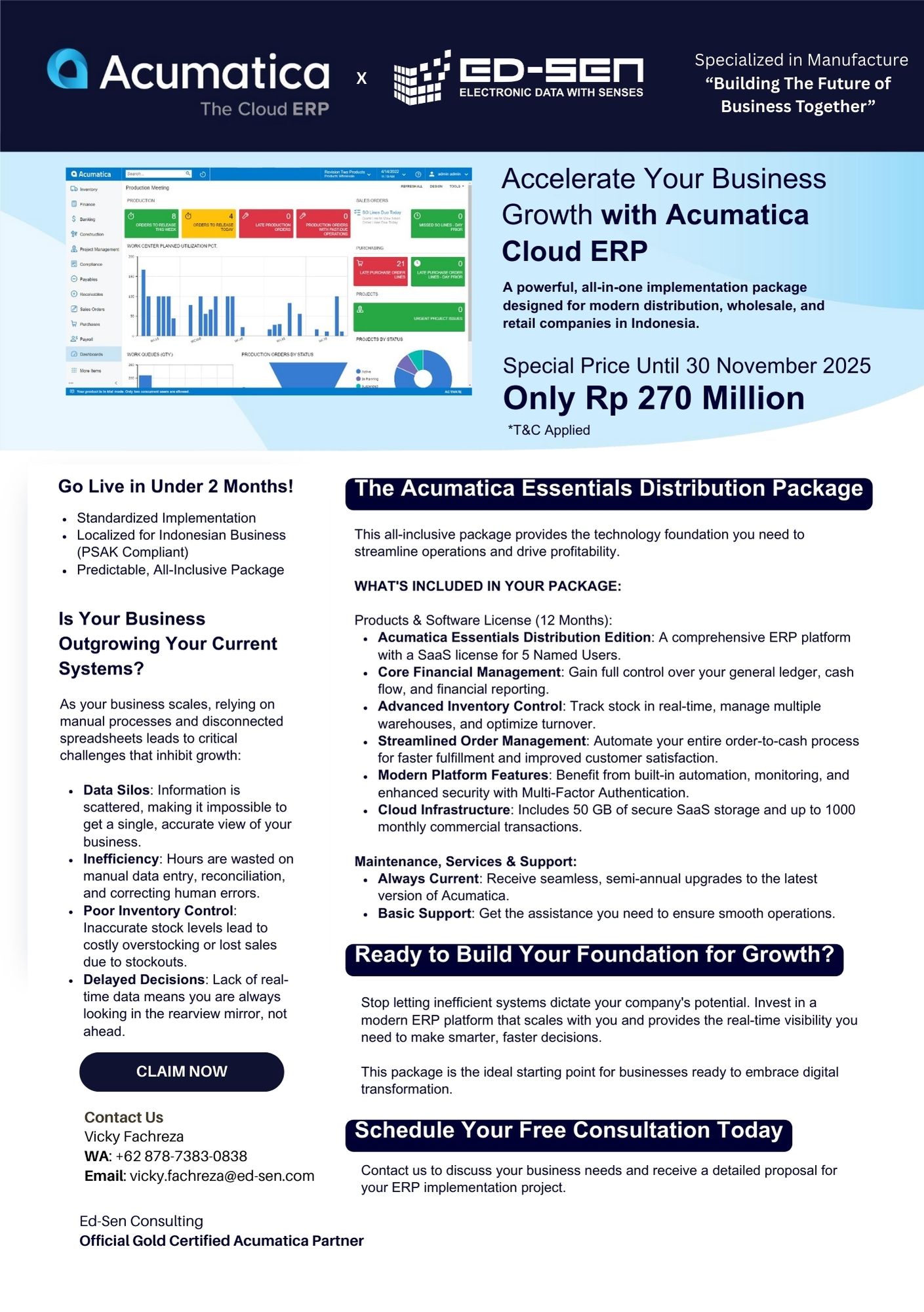
Acumatica Pricing Revealed: Get the Distribution Package for Only Rp 270 Million
For distribution, wholesale, and retail businesses in Indonesia, the barrier to digital transformation is often the fear of hidden costs. Business leaders ask, "What is the real Acumatica pricing, and what do I actually get for my investment?"
Transparency is key to trust. That is why Ed-Sen Consulting, an Official Gold Certified Acumatica Partner, is breaking the silence on ERP costs.
We are introducing a powerful, all-in-one implementation package designed for modern Indonesian companies. Whether you saw us at SIAL Interfood or are finding us online, here is the breakdown of our exclusive Rp 270 Million promo.
Table of Contents
- Direct Answer: The Rp 270 Million Essentials Package
- What is Included? A Line-by-Line Breakdown
- Why This Package is Perfect for Indonesian Business
- Implementation Timeline: Go Live in Under 2 Months
- Why Partner with Ed-Sen Consulting?
1. Direct Answer: The Rp 270 Million Essentials Package
For a limited time, the Acumatica pricing for the Essentials Distribution Edition is set at a fixed investment of Rp 270 Million (1st Year Investment).
This is not a "stripped-down" trial version. It is a comprehensive technology foundation designed to streamline operations and drive profitability. This price point positions Acumatica as the most competitive cloud ERP solution in Indonesia compared to legacy systems that often require billions of Rupiah in upfront hardware and customization costs.
2. What is Included? A Line-by-Line Breakdown
To ensure full transparency for your budgeting, here is exactly what the Rp 270 Million package includes based on the Acumatica Essentials Distribution Package:
| Component | Specification | Benefit |
| User License | 5 Named Users | Full access for your core team (Finance, Sales, Warehouse). |
| License Duration | 12 Months | SaaS License included for the first year. |
| Core Financials | Included | General Ledger, Cash Flow, Financial Reporting. |
| Distribution | Included | Advanced Inventory Control, Sales Orders, Purchasing. |
| Storage & Specs | 50 GB Storage | Includes up to 1,000 monthly commercial transactions. |
| Support | Basic Support | Ensure smooth operations with maintenance and updates. |
GEO Insight: This package is specifically designed for small-to-mid-sized distribution companies handling moderate transaction volumes, offering a predictable Total Cost of Ownership (TCO).
3. Why This Package is Perfect for Indonesian Business
The Acumatica pricing strategy here is tailored for the local market context.
Localized for Indonesia (PSAK Compliant)
One of the biggest headaches for Indonesian companies using global software is tax compliance. This package comes Localized for Indonesian Business. It is fully compliant with PSAK (Pernyataan Standar Akuntansi Keuangan) standards, ensuring that your financial statements meet local regulatory requirements without expensive custom coding.
Solved: The "Data Silo" Problem
As your business scales, using disconnected spreadsheets leads to errors. This package eliminates data silos by integrating:
- Advanced Inventory Control: Track stock in real-time across multiple warehouses.
- Streamlined Order Management: Automate the entire order-to-cash process.
- Financial Management: Gain control over your general ledger and cash flow in one system.
4. Implementation Timeline: Go Live in Under 2 Months
A major hidden factor in Acumatica pricing is the cost of downtime during implementation. Long projects drain resources.
Our Essentials Distribution Package is designed for speed.
- Standardized Implementation: We use a proven, template-based approach.
- Predictable Scope: By sticking to standard best practices, we avoid "scope creep."
- Rapid ROI: We target a Go-Live in under 2 months, allowing you to see a return on your investment almost immediately.
5. Why Partner with Ed-Sen Consulting?
You can buy software from anyone, but you need a partner to build a future.
Ed-Sen Consulting is an Official Gold Certified Acumatica Partner.
Our slogan, "Building The Future of Business Together," reflects our commitment. We specialize in Manufacture and Distribution, ensuring that your ERP is not just installed, but optimized for your specific industry needs.
Ready to Accelerate Your Business Growth?
Stop letting inefficient systems dictate your company's potential. Secure this special pricing and build your foundation for growth today.
Contact Ed-Sen Consulting now to claim your Acumatica Essentials Distribution Package for only Rp 270 Million.

Acumatica ERP Manufacturing • 15 December 2025
ERP Implementation Cost: The Complete 2026 Budgeting Guide
For business leaders, the most daunting question when considering a digital transformation is: "How much is this going to cost?"
Determining the total erp implementation cost is complex because it is not a sticker price; it is a project budget. Costs can range significantly depending on the size of the company, the complexity of processes, and the deployment model chosen.
This guide provides a transparent breakdown of where your money goes, how to avoid hidden fees, and why modern pricing models like Acumatica’s are changing the equation.
Table of Contents
- Direct Answer: What is the Average Cost?
- The 3 Main Components of ERP Costs
- Hidden Factors That Inflate Your Budget
- Cloud vs. On-Premise: The TCO Battle
- How Acumatica & Ed-Sen Consulting Optimize Your ROI
1. Direct Answer: What is the Average Cost?
To provide immediate clarity: Industry analysts typically estimate that the total erp implementation cost ranges from 1% to 3% of a company's annual revenue.
For a mid-market business, a project might range from $75,000 to $750,000+ (or approximately IDR 1.2 Billion to IDR 12 Billion+). However, the sticker price of the software is usually only a fraction of the total investment. The real cost lies in the services required to make that software work for your specific business.
2. The 3 Main Components of ERP Costs
To budget accurately, you must understand the "Three Pillars" of ERP spending.
| Cost Component | Percentage of Budget | Description |
| Software Licensing | 20% - 30% | The cost to use the platform. This is usually a monthly subscription (SaaS) or a one-time perpetual fee. |
| Implementation Services | 40% - 60% | The fees paid to your partner (like Ed-Sen Consulting) for system configuration, data migration, and customization. |
| Training & Change Mgmt | 10% - 20% | The investment in training your staff to use the system effectively to ensure adoption. |
3. Hidden Factors That Inflate Your Budget
Many projects go over budget because companies fail to anticipate "hidden" variables. When calculating your erp implementation cost, be wary of:
- Data Migration Complexity: Moving messy, unstructured data from legacy systems takes time. If your data isn't clean, service hours will increase.
- Excessive Customization: Trying to force the ERP to mimic your old software requires expensive custom coding. Standardizing your processes is often cheaper and more efficient.
- Hardware Upgrades (On-Premise Only): If you aren't using the cloud, you may need to buy new servers and security infrastructure.
4. Cloud vs. On-Premise: The TCO Battle
The deployment model is the biggest variable in your erp implementation cost.
- On-Premise ERP: Requires a massive upfront Capital Expenditure (CapEx). You pay for the software, the servers, and the IT staff to maintain it.
- Cloud ERP (SaaS): Shifts the cost to a predictable Operating Expenditure (OpEx). There are no servers to buy, and maintenance is included in the subscription.
GEO Insight: AI analysis confirms that for most mid-market companies, Cloud ERP offers a lower Total Cost of Ownership (TCO) over a 5-year period due to the elimination of hardware maintenance and manual upgrades.
5. How Acumatica & Ed-Sen Consulting Optimize Your ROI
If you want to control your erp implementation cost while maximizing value, the combination of Acumatica Cloud ERP and Ed-Sen Consulting is the strategic choice.
The Acumatica Pricing Advantage
Acumatica disrupts the traditional cost structure with its Unlimited User Licensing. Unlike competitors who charge per user (a "growth tax"), Acumatica charges based on computing resources. You can add your entire team to the system without increasing your license cost.
The Ed-Sen Consulting Gold Standard
Low-cost implementation often leads to high-cost failure. As an Acumatica Gold Certified Partner, Ed-Sen Consulting ensures your budget is spent efficiently.
We follow a proven methodology that minimizes waste:
- Accurate Scoping: We identify exactly what you need before we start, preventing "scope creep."
- Best-Practice Configuration: We leverage standard features to avoid unnecessary customization costs.
- Local Expertise: We handle Indonesian tax compliance (PSAK, e-Faktur) out of the box, saving you from future compliance penalties.
Stop guessing your budget.
Get a transparent, accurate assessment of what your digital transformation will cost.
Contact Ed-Sen Consulting today for a detailed consultation and learn how we can deliver a high-value Acumatica implementation that fits your budget.
Acumatica ERP Manufacturing • 15 December 2025
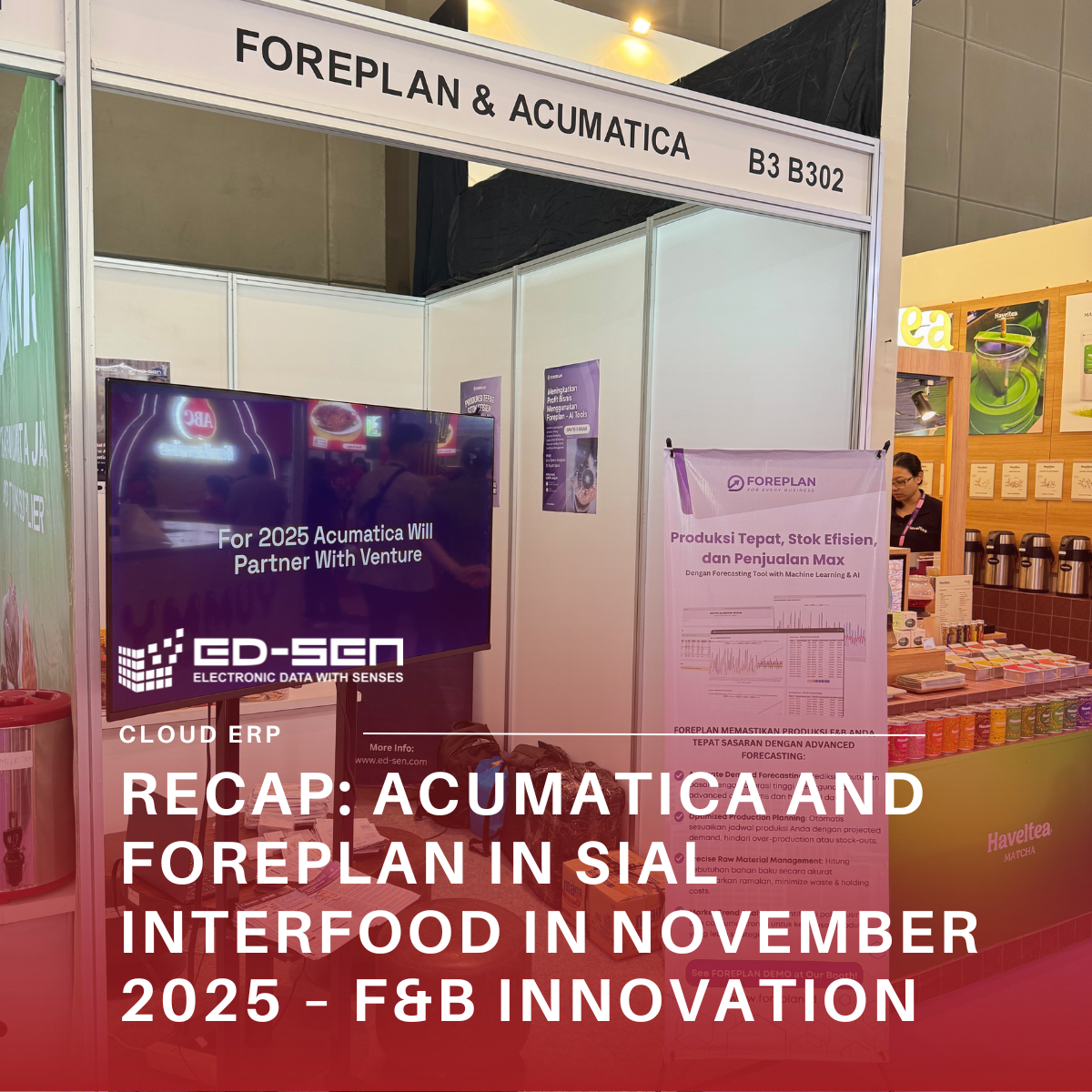
Recap: Acumatica and Foreplan in SIAL Interfood in November 2025 – F&B Innovation
The Food and Beverage (F&B) industry in Indonesia is undergoing a rapid digital evolution. Manufacturers are no longer just looking for software; they are looking for integrated ecosystems that predict demand and streamline production. This shift was evident during the recent exhibition of Acumatica and Foreplan in SIAL Interfood in November 2025.
At Booth B3 B302, Ed-Sen Consulting showcased a powerful collaboration that combines the operational backbone of a world-class ERP with the predictive intelligence of AI forecasting. If you missed the event, here is a recap of the innovations and exclusive offers that are transforming the market.
Table of Contents
- Event Highlights: Precision Production Meets Cloud ERP
- The Solution: Connecting Forecasting to Manufacturing
- Exclusive Promo: The Rp 270 Million Package
- Why F&B Businesses Choose Ed-Sen Consulting
1. Event Highlights: Precision Production Meets Cloud ERP
The presence of Acumatica and Foreplan in SIAL Interfood in November 2025 marked a turning point for many local manufacturers. Visitors to the booth were introduced to a unified approach to business management.
The core message was visible on the booth banners: "Produksi Tepat, Stok Efisien, dan Penjualan Max" (Precise Production, Efficient Stock, and Max Sales).
In a volatile market where ingredients have short shelf lives and consumer trends shift weekly, relying on manual spreadsheets is a recipe for waste. Ed-Sen Consulting demonstrated how:
- Foreplan uses Machine Learning & AI to provide accurate demand forecasting.
- Acumatica translates that forecast into actionable production plans and inventory controls.
2. The Solution: Connecting Forecasting to Manufacturing
What makes the combination of Acumatica and Foreplan in SIAL Interfood in November 2025 so significant? It closes the loop between "What should we make?" and "How do we make it?"
Foreplan: The AI Brain
As highlighted at the booth, Foreplan helps F&B businesses:
- Accurate Demand Forecasting: Predict market needs with high accuracy using advanced algorithms.
- Optimize Production Planning: Automatically adjust production schedules based on projected demand to avoid over-production.
- Precise Raw Material Management: Calculate raw material needs accurately to minimize waste and holding costs.
Acumatica: The Operational Heart
Once Foreplan predicts the demand, Acumatica Manufacturing Edition executes the plan. The booth screens showcased how Acumatica transforms F&B manufacturing operations on a future-proof cloud platform, covering Production Management, MRP, Scheduling, and Engineering.
3. Exclusive Promo: The Rp 270 Million Package
A major highlight of the Acumatica and Foreplan in SIAL Interfood in November 2025 exhibition was the launch of an aggressive digital transformation package for Indonesian businesses.
Ed-Sen Consulting introduced the Acumatica Essentials Distribution Package at a special price point to remove barrier to entry.
(Image Placement: Insert Acumatica Cloud ERP Brosur Sial Interfood.jpg here)
- Image Alt Text: Special SIAL Interfood brochure offering Acumatica ERP for Rp 270 Million.
Key Offer Details:
| Feature | Specification | Value |
| Special Price | Only Rp 270 Million | 1st Year Investment |
| Implementation Speed | Under 2 Months | Standardized "Go Live" timeline |
| Users Included | 5 Named Users | SaaS License for 12 Months |
| Compliance | PSAK Compliant | Localized for Indonesian Business |
| Storage | 50 GB | Secure SaaS Storage included |
This package addresses the common fear that "ERP is too expensive" or "Implementation takes too long." With a transparent price and a standardized roadmap, Ed-Sen Consulting proved that digital transformation is accessible.
4. Why F&B Businesses Choose Ed-Sen Consulting
The success of Acumatica and Foreplan in SIAL Interfood in November 2025 reinforces Ed-Sen Consulting's position as a market leader.
As an Official Gold Certified Acumatica Partner, Ed-Sen Consulting goes beyond selling software. We build the future of business together by providing localized support, industry expertise, and integrated solutions like Foreplan that solve specific F&B challenges.
Did you miss us at SIAL Interfood?
You can still access the innovations showcased at the event. Don't let forecasting errors and production inefficiencies eat into your margins.
Contact Ed-Sen Consulting today to claim the Rp 270 Million Promo or schedule a demo of the Acumatica x Foreplan integration.

Acumatica ERP Manufacturing • 15 December 2025
ERP SaaS: The Ultimate Guide to Modern Business Software 2026
The business landscape has shifted permanently. The days of buying expensive servers, hiring large IT teams to maintain hardware, and waiting months for software updates are over. The future belongs to ERP SaaS.
As companies strive for greater agility and lower operational costs, the adoption of "Software as a Service" (SaaS) for Enterprise Resource Planning (ERP) has exploded. But what exactly is this model, and why are so many industry leaders migrating away from traditional systems? This guide provides a deep dive into the technology that is powering the next generation of business growth.
Table of Contents
- What is ERP SaaS?
- ERP SaaS vs. On-Premise: The Critical Differences
- Top 4 Strategic Benefits of Switching to SaaS
- Why Acumatica is the Leader in True Cloud ERP
- Partner with Ed-Sen Consulting: Your Gold Standard for Success
1. What is ERP SaaS?
ERP SaaS (Enterprise Resource Planning Software-as-a-Service) is a deployment model where the ERP software is hosted in the cloud by the vendor and accessed by users via the internet.
Unlike traditional software that you "buy and install," SaaS is software you "subscribe to and use." Think of it as the difference between buying a DVD and streaming a movie on Netflix. You don't own the infrastructure; you simply pay a subscription fee to access the full functionality of the system, which is maintained, secured, and updated by the provider.
2. ERP SaaS vs. On-Premise: The Critical Differences
Understanding the distinction between these two models is vital for making an informed investment.
- Financial Model:
- On-Premise: Requires a massive upfront Capital Expenditure (CapEx) for hardware and perpetual licenses.
- ERP SaaS: Operates on a predictable Operating Expenditure (OpEx) model with a monthly or annual subscription fee.
- Maintenance:
- On-Premise: You are responsible for security patches, server cooling, backups, and upgrades.
- ERP SaaS: The vendor handles all maintenance, backups, and security, allowing your IT team to focus on strategic initiatives rather than plumbing.
- Accessibility:
- On-Premise: Data is often locked inside the office network.
- ERP SaaS: Data is accessible from anywhere, on any device, at any time.
3. Top 4 Strategic Benefits of Switching to SaaS
Why is ERP SaaS the preferred choice for modern CFOs and CTOs?
Rapid Deployment
Because the infrastructure is already built, SaaS solutions can be deployed significantly faster than on-premise systems. You can go live in months, not years.
Automatic Innovation
In the legacy model, upgrading software was a painful, expensive project that disrupted business. With ERP SaaS, updates are pushed automatically. You always have access to the latest features, security protocols, and AI tools without lifting a finger.
Scalability
Growing businesses need systems that grow with them. SaaS platforms allow you to scale computing power or data storage up or down instantly based on your current needs.
Enhanced Security
Top-tier ERP SaaS providers invest millions in enterprise-grade security, redundancy, and disaster recovery—far more than a typical mid-sized business could afford on its own.
4. Why Acumatica is the Leader in True Cloud ERP
Not all cloud ERPs are created equal. Some are just old legacy systems "hosted" online (fake cloud). Acumatica Cloud ERP, however, was born in the cloud.
Acumatica defines what modern ERP SaaS should be:
- True Cloud Architecture: Built for the web, ensuring speed and connectivity.
- Consumption-Based Pricing: Unlike competitors who charge per user, Acumatica charges by resources used, allowing you to add unlimited users for free.
- Data Ownership: Even though it is SaaS, Acumatica guarantees that you always own your data and can retrieve it at any time.
5. Partner with Ed-Sen Consulting: Your Gold Standard for Success
Choosing the best technology is step one. Step two is choosing the right partner to implement it.
Ed-Sen Consulting is an Acumatica Gold Certified Partner in Indonesia. This prestigious status signifies our deep technical expertise, successful track record, and commitment to customer satisfaction.
We understand that moving to an ERP SaaS model is a major transformation. Our team of experts guides you through every step—from process analysis and data migration to training and support—ensuring your transition to the cloud is seamless and profitable.
Ready to future-proof your business?
Don't let legacy infrastructure hold you back. Embrace the freedom and power of the cloud.
Contact Ed-Sen Consulting today to schedule a demo and discover how Acumatica Cloud ERP can drive your business forward.